
Blue UAS approved Remote ID for your drone
The DroneBeacon db300 is, as of October 2026, the only Standard Remote ID module on the U.S. DoW/DoD Blue UAS Framework. Build it into your drone and Remote ID is one part your drone’s Blue UAS review doesn’t need to assess again: it’s NDAA compliant (Sections 848 and 889), FCC certified, works with ArduPilot and PX4, and comes with help for your FAA Declaration of Compliance.
Approved on the Blue UAS Framework on 10 July 2026. Verify it on the official Framework List (search for “db300”).
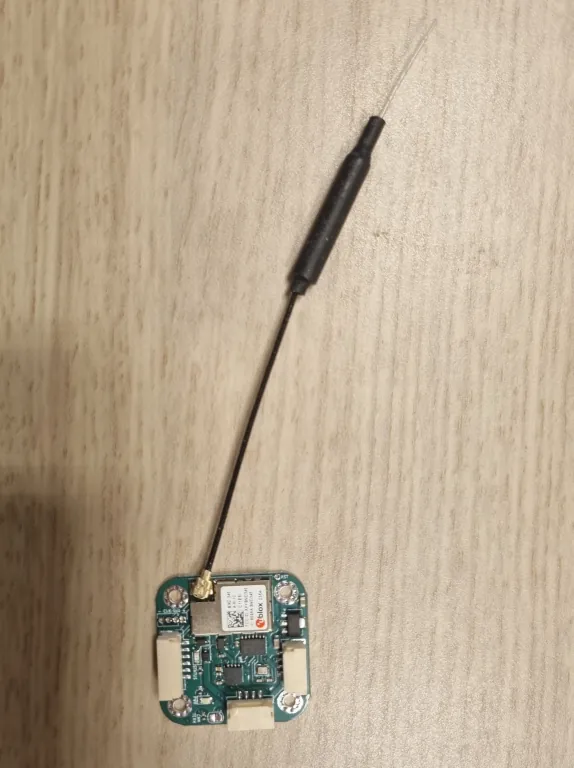
Two things off your list
1. Blue UAS and NDAA
The db300 is approved on the Blue UAS Framework and verified NDAA compliant (Sections 848 and 889). In your drone’s Blue UAS review, the Remote ID part doesn’t need to be assessed again. No digging into radio chips and suppliers.
2. Remote ID compliance
Remote ID is our specialty. We follow the FAA and EASA rules and standards, and keep the db300’s firmware up to date with them, so you don’t have to. The db300 complies with ASTM F3411-22a for the FAA and ASD-STAN EN 4709-002 for Europe, and broadcasts over Bluetooth 4 Legacy and Bluetooth 5 Long Range with an FCC certified radio. It plugs into ArduPilot and PX4, so Remote ID just works. Your drone still needs an FAA Declaration of Compliance, and our manual and template (part of our partner program) make that a straightforward job.
What the US rules mean for your drone
Selling drones to US government, defense or federally funded customers now means meeting several rules at once. Here’s what each one means for the Remote ID part of your drone:
| Rule | What it requires | What it means for Remote ID |
|---|---|---|
| FAA Remote ID (14 CFR Part 89) | Drones flown in the USA must broadcast Remote ID. New drones need Standard Remote ID built in, with an FAA-accepted Declaration of Compliance from the manufacturer. | You need an integrated module such as the db300, plus a DoC. Our partner program helps with the DoC. |
| Proposed Part 108 (BVLOS) | As proposed, every drone flying under Part 108 needs Standard Remote ID; a broadcast module isn’t enough. Not in force yet. | Standard Remote ID becomes the norm for BVLOS operations such as delivery and inspection. |
| NDAA Sections 848 and 889 | No drones or critical components, such as radios and data transmission devices, from covered countries like China, and no equipment from restricted vendors. | The Remote ID radio counts. The db300 uses a u-blox/Nordic radio and is verified NDAA compliant. |
| American Security Drone Act | Since 22 December 2025, federal agencies, and contractors and grant recipients spending federal money, may no longer buy or fly drones from covered foreign entities. | Federal buyers look for NDAA compliant and Blue UAS drones, down to the components. |
| Blue UAS (DoD, run by DCMA) | The Cleared List of complete drones, and the Framework of approved components. A drone’s review covers every component that isn’t approved yet. | The db300 is on the Framework, so it doesn’t need to be assessed again in your drone’s review. |
| FCC Covered List | Since 22 December 2025, new covered drones and critical components can no longer get FCC equipment authorization. | Not an issue for the db300: its radio module already has FCC authorization (FCC ID XPYBMD345), so no new authorization is needed. |
More background: Remote ID rules in the United States. Official sources: 14 CFR Part 89, Part 108 proposal, FCC Covered List.
This is a summary, not legal advice. Check the rules for your own product and customers.
What the db300 saves you
Every drone sold in the USA needs Remote ID. Drones for government and defense customers also need NDAA compliance and, increasingly, a Blue UAS review of the complete drone. That review covers every component, and for a complex drone with many components it can easily cost well above $100,000. The Blue UAS program is built so that you can use components that are already approved, like the db300. They don’t need to be assessed again, so every approved component saves time and money in your drone’s review.
| Your drone needs | With the db300 |
|---|---|
| Blue UAS review of the Remote ID part | Done. On the Framework List since 10 July 2026, so no further assessment is needed |
| NDAA compliance (Sections 848 and 889) | Verified as part of the Blue UAS approval |
| FCC certified radio | Done: FCC certified radio module (FCC ID XPYBMD345) |
| Remote ID standard | Compliant with ASTM F3411-22a and ASD-STAN EN 4709-002 |
| Integration with your autopilot | Plug and play with ArduPilot and PX4 over MAVLink or DroneCAN |
| Firmware updates | Maintained by us (firmware 1.4 latest version) |
| FAA Declaration of Compliance | Manual and template through our partner program |
| Reliable supply and support | In stock, and direct answers from the team that developed it |
| A predictable unit cost | €69 ex. VAT, with volume discounts |
Using approved components doesn’t make your drone Blue UAS cleared on its own: the complete drone is still reviewed. But each approved component, like the db300, is a part of your drone that doesn’t need to be assessed again.
Already have your own Remote ID module? In your drone’s Blue UAS review, it has to be assessed like any other component that isn’t approved yet, including its radio chip and its suppliers under NDAA Section 848. Switching to the db300 removes that part from the review.
Not going for Blue UAS yet? Choose the db300 anyway, so your design is future-proof. If you later want government or defense customers, or a Blue UAS review of your drone, the Remote ID part is already approved and NDAA compliant: no redesign needed.
Why the db300
- Blue UAS approved: listed on the U.S. DoD Blue UAS Framework.
- NDAA compliant: Sections 848 and 889, with no components from covered countries. The radio is a u-blox BMD-345 (Nordic nRF52840).
- FCC/CE certified radio module with an external PA: +18 dBm, or +20 dBm EIRP (100 mW) with the included 2 dBi antenna.
- Bluetooth 4 Legacy + Bluetooth 5 Long Range, as required by the FAA.
- Plugs into your autopilot: 2× DroneCAN (CAN 2.0 and CAN FD) and 1× MAVLink (UART), with JST-GH connectors. Supported by ArduPilot 4.3+ and PX4 v1.14+. The GCS shows Remote ID status and warnings.
- Small and light: 27.5 × 27.5 mm and 2.5 g, -40 °C to +85 °C.
- Drop-in replacement for the db201: the same MAVLink and DroneCAN messages, so no changes on the autopilot side. An existing design can switch to Blue UAS easily.
- Reliable supply: we aim to always keep the db300 in sufficient stock, so your production never waits on Remote ID. €69 ex. VAT, with volume discounts.
- Direct support: questions about integration, configuration or your FAA DoC go straight to the team that developed the db300.
We help you get your FAA Declaration of Compliance accepted
A Standard Remote ID drone needs an FAA-accepted Declaration of Compliance (DoC) from its manufacturer. That’s you, even when the Remote ID module comes from us. Our free partner program makes this a short project instead of a long one:
- DoC manual and template, based on the db300’s test results and documentation.
- Know-how on EMC and international rules for drone manufacturers.
- Net 30 payment terms.
Customers who buy 50 or more Remote ID modules join automatically. Need custom firmware or integration work? We also offer paid engineering services.
BlueMark specializes in Remote ID for the FAA and EASA markets, and is trusted by over twenty drone companies.
Firmware 1.4
- CAN FD support for faster DroneCAN buses (up to 8 Mbps).
- Firmware updates over CAN with the standard DroneCAN GUI Tool: update the module inside the drone, without opening it up. This comes on top of Bluetooth (OTA) and SWD.
- Extra DroneCAN functions you can call or query from the DroneCAN GUI Tool, such as erase all and transport statistics.
- Bug fixes.
Frequently asked questions
Is the db300 on the Blue UAS Framework?
Yes. It was approved on 10 July 2026 and is listed on the official Blue UAS Framework List. As of October 2026, it’s the only Standard Remote ID module on the Framework.
Does the db300 make my drone Blue UAS cleared?
No. The complete drone is reviewed for the Blue UAS Cleared List. But approved components like the db300 don’t need to be assessed again, which saves time and costs in your drone’s review.
We already have our own Remote ID module. Why switch to the db300?
Your own module has to be assessed in your drone’s Blue UAS review, including its radio chip and suppliers under NDAA Section 848. The db300 is already approved, so that part of the review falls away. It also comes with FAA DoC support and maintained firmware.
We don’t need Blue UAS yet. Why choose the db300?
Because it keeps your options open. If you later sell to government or defense customers, or submit your drone for Blue UAS, the Remote ID part is already approved and NDAA compliant, so you don’t need to redesign it.
Do I still need an FAA Declaration of Compliance?
Yes. As the drone manufacturer, you submit the DoC for your Standard Remote ID drone. Our partner program gives you a manual and template to get it accepted quickly.
Do I need my own FCC certification for the radio?
Not for the Remote ID radio: the db300 uses an FCC certified module (FCC ID XPYBMD345). Your drone as a whole still has to meet the FCC rules for its other electronics.
Which autopilots are supported?
ArduPilot 4.3 and newer and PX4 v1.14 and newer, over MAVLink or DroneCAN. The db300 is a software drop-in for our db201: the same MAVLink and DroneCAN messages, so nothing changes on the autopilot side. The module itself is smaller.
Can I get volume pricing?
Yes. We aim to always keep the db300 in stock. The db300 costs €69 ex. VAT, with volume discounts on the product page. For product or integration questions, you get direct support from our team. Contact us.